A screwdriver sends force into a screw through a handful of small contact surfaces. When the driver slips, those surfaces can round over. The panel stays closed, and the work shifts from replacing a part to extracting a damaged fastener. The screw head has become the first failed component of the repair.
It is easy to call a screw “removable” because it can, in principle, turn. A repairer needs more than that: a driver that fits the recess, room to hold it in line, and enough information to put the right fastener back. Each requirement is small enough to disappear in a product description. Together, they decide whether opening an object is ordinary work or a second problem to solve.
A cross is not a measurement
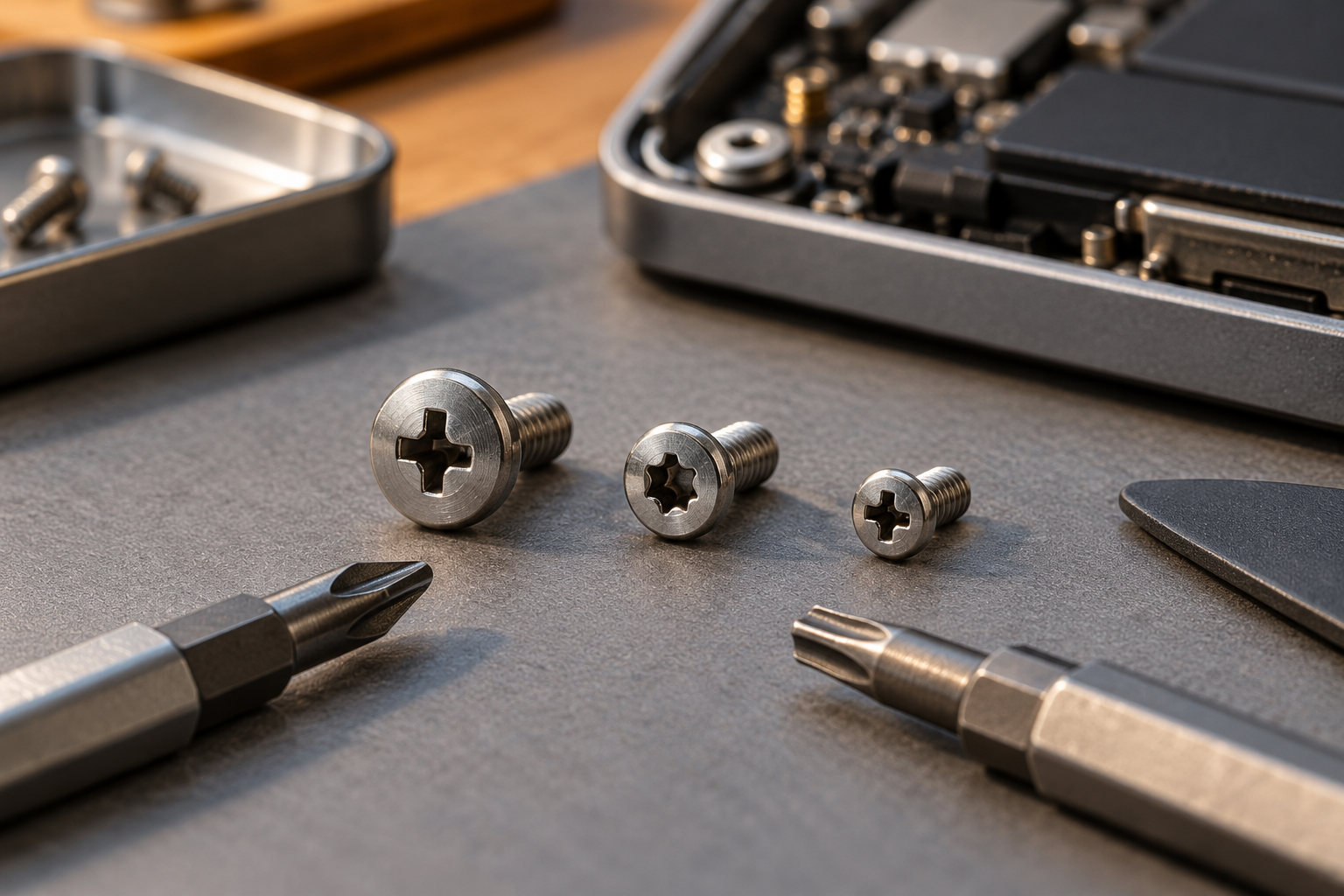
Look closely at two cross-shaped screw heads and their similarity can be misleading. The public abstract for ISO 8764-1 distinguishes PH driver tips for H-form recesses from PZ tips for Z-form recesses. These are specified shapes and dimensions, not two names for any bit that looks roughly like a cross. The standard's full dimensional tables are not public in that abstract, so it cannot tell us which driver fits an unidentified screw on a workbench.
A manufacturer's tool list makes the distinction tangible. A Wera combination blade carries a PH tip on one end and a PZ tip on the other. Both serve cross recesses; the blade changes ends because the profiles differ. A repairer who has found a tip that enters the recess has only begun checking the fit.
The iFixit screwdriver guide asks for contact across the recess's width and depth. A bit that is too small can move inside the head and damage it. One that is too large may only catch near the opening. The guide recommends comparing neighboring sizes and using a snug fit. This is a practical test, not a license to force a reluctant bit deeper.
The condition of the bit matters alongside its size. The same guide warns that a tip bent by prying or damaged by other misuse may no longer seat properly. Before blaming a reluctant screw, a repairer can inspect the tool's edges. A worn tip can make a correctly named driver behave like the wrong one, and a fresh bit may preserve the recess that repeated slips would destroy.
Other recesses have their own geometries. ISO 10664's public abstract describes the shape, basic dimensions and gauging of a hexalobular internal drive. The existence of a standard matters here because a repair can begin with a named interface: a matching tip can be made, checked and specified. It does not mean every six-lobed recess has been identified by sight or that every screw using it is easy to reach.
The hand needs a route to the head
A well-fitting bit works best when the driver can stay aligned with the screw. iFixit's guide calls for holding the shaft in line with the fastener and maintaining contact while turning. A screw buried behind a lip or close to a wall may make that posture difficult. This is a design constraint as well as a matter of technique: the screw's location affects whether a person can apply force through its intended surfaces.
Imagine a hypothetical access panel with one fastener down a narrow recess. The repairer can see the head but has only a bulky handle and a short bit. Tilting the tool lets it touch the screw, yet leaves less surface engaged. A longer, narrow-shaft driver might solve the reach problem; moving the screw nearer the opening would solve it in the design. No real device is being described. The example shows why visibility and access are different claims.
Pressure matters too. The iFixit guide recommends steady downward force to keep a driver seated. That advice is conditional on safe access and a good fit. More force through the wrong bit does not repair the geometry. If the driver starts slipping, the useful response is to stop and inspect the head and tool before the recess loses still more of its shape.
The other end of the repair
Removal is only half of the fastener's job. A replacement needs the right thread and length as well as a drive shape. The Framework Laptop 16 fastener guide offers a concrete example: its kit distinguishes several screws with T5 heads from others with PH0 heads, and identifies each by diameter, length and where it belongs. It also says the kit replaces non-captive screws; the captive ones call for different handling. The guide's specificity makes a small but important design choice visible. A person can identify a lost screw by the assembly it held, rather than guessing from the recess alone.
That does not prove every Framework repair is simple, and the example is confined to the model and guide cited. It does show how standardized drives and a parts map can work together. A common screwdriver bit makes the first turn possible. A documented fastener makes reassembly less of an act of memory.
The distinction becomes more useful as screws accumulate on the mat. Several can share a drive shape while differing in length or diameter. Keeping them grouped by the place they came from, and checking those groups against a parts map, preserves information that the head alone does not carry. The maker's documentation turns a pile of similar metal pieces back into the specific joints they held.
What happens after a head is already damaged changes the scale of the job. In iFixit's stripped-screw guide, the first step is to try a driver that can catch and to stop if it does not. Later options include gripping an exposed head with extracting pliers or cutting a new slot. That last method can scatter metal particles around electronics and requires protective measures. The progression matters: extraction has its own tools and risks. It is not simply “turn harder.”
A good repair guide can name the driver before the cover comes off, show where the screws go, and distinguish captive fasteners from loose ones. A good product layout gives that driver enough room to meet the head squarely. The screw may be one of the cheapest parts in the object, but the repair crosses through it twice: once on the way in, and again when everything has to hold together afterward.
A thought worth keeping?